Oct 26/2013. This page is a combination of the 'Sharpening', 'Sprained Ankles', and 'Step Extreme' pages. The info on those pages really needs to be cleaned up, so I'm consolidating it here and will then be updating everything into a general page on the skates.


This page is a compilation of a series of posts I put up in the winter of 2013 as I tried out the Step Extreme blade. I haven't finished experimenting with them and will continue to post info, but I think I have made up my mind about these blades. They are not for everyone, and frankly, they aren't for me as they are when they are brand new. They are too high and too long. However, as you sharpen blades, they get lower and a little shorter, and as this happens with my Step Extremes, I'm liking them more. This explains why I am still going to be posting on this page, and my last post will be when I think they are at the perfect height and length. Of course, I have been playing with the blades for a while now, so my opinion will be somewhat biased. Ask around for other opinions. Briefly, the problem I have found with these blades is that the height creates a lot of sideways wobble, and the length reduces your agility on a number of moves. I don't think the NHL needed to outlaw them, because as they are, not many goalies will use them. However, if I am right about these problems, Step can easily fix them, and don't forget that Step has another blade that is lower, and almost anyone can use them.
step

Sept/2013
As for the Step Extremes. Lots going on there. I wasn't liking them all that much because they just feel too long. Sometimes it feels like you're on skis, and you do lose some pivoting ability (going behind the net, butterfly slide or backdoor move going back). Also, they feel a little too high. They are definitely the extreme of what a blade should be. So I took them off to see what my old blades were like. They are old Step blades worn down to what a normal blade would be when you buy it. I didn't like them either. The Extremes really give you great edge when you are down, and a wide stance is rock solid. So I'm kind of stuck between the two. I'm having the Extremes ground down a bit to hopefully find a height I can work with.

So I had the Extremes ground down and they are much better. I think a little bit more and they'll be perf. I'll have photos and I'll be moving all this stuff to its own page. To get around the NHL, Step should just raise the normal Step blade a little and call it 'intermediate' or something like that. Also, shortening it would be good.


If you need some background info on why Step would make a blade like this, read the Graf install page. It is important that you understand why the height and width of a goalie skate is important. Above is a shot of my skates with the new Step Extreme blade, and below is a shot of my skates with the Step regular blade, which is still higher than a normal goalie blade. I have used the Extreme about 10 times and I'm just getting used to it. With the regular Step blade, there was zero break-in time, and that is a big deal when you consider that there is no rocker on the blade yet. I would say that the regular Step blade can be used by any goalie and is a great product. With the Extreme blade, it is extreme. You definitely feel higher and because of this, there is some noticeable ankle wobble. If you use this blade, I'm fairly sure you will have to tape your ankles to control this wobble.

So does this blade deliver more power? Yup; no doubt about it. You can take a wider stance, push off harder, get up easier. For that reason, if you aren't wearing Overdrive, it reduces the need for it a bit. Combined with Overdrive, it makes a great mobility package.
So, assuming you know why higher is better (Graf Install page) and why that makes these blades better, let's look at the downside. I can see only two problems, and neither are that big a deal. (Correction: I now think they are a big deal. J. Sept/13)

1 - Excessive wobble at the ankles can cause sprained ankles. If you are sliding your foot sideways and you catch a rut, it's going to hurt more with these blades because you are higher up and can roll your ankle more. This was why I first started taping my ankles. I got a sprain and it took forever to heal because as soon as it was getting better, I would sprain it again, and each time it took less of a catch to re-sprain it. After taping my ankles, I discovered that I had better control over my edges because I had reduced ankle wobble. I've mentioned it elsewhere on this site that every time your ankles wobble, you shift from one edge to the other. You need total control over your edges, especially the inside edge. This is most noticeable when you are moving laterally. You need your inside edge for those moves, but ankle wobble will shift you from one edge to the other, and that instability will make it harder to focus on the puck and harder to complete the move. When you stop, it will take a split second longer to re-establish your footing. So the simple solution is to tape your ankles, which I recommend to all goalies anyway, whether you wear Overdrive or Step or not. You will protect your ankles and control your moves better. One simple test to find out if you need to tape your ankles is to go skating - without equipment. If you feel wobbly without the pads on (a lot of goalies will), then you need better control of your edges. I'll mention later how I tape mine. On this note, even though I tape my ankles a lot, I still noticed more wobble with the Extreme blade and had to tape them more, but that could be because my boots are getting old and have a few soft spots.

2 - Whenever you get new blades, they will be profiled, but you will have less rocker than your old blades simply because the new ones haven't been sharpened much yet. It's nice to have a long, flat blade, but only to a point. When you go down, it won't be as smooth as with your old blades because the front and back of the blade don't yet have that curve from sharpenings. With the Step Extreme, I notice this a lot. Because the blade is higher, it is also a little bit longer, so you'll have more edge at the front and back of the blade. I found that this caused me to catch my foot a few times as I was getting up. In the past, I've had this problem with new blades, but it went away after one or two games. With these blades, it still feels a little funny after ten games. But, I don't consider this a big deal at all. If it bothered me a lot, I would just have them ground down a bit. As it is, I'm almost used to these blades, and after five sharpenings, the curve on the blades will be fine. I'm keeping these blades and I'm liking them more with every use.

Having raised the subject of taping your ankles, I think I had better put up some info on it, because it is not as simple a subject as you would think. I'll post that below in a week.

Got questions about this? Send me a mail or give me a call.

As I said above, I think it is very important for goalies to tape their ankles, and again, if you aren't sure of why, try skating without equipment to see how much control you have over your edges. You may be surprised at how unstable you feel. This has to be fixed, and until someone finally comes out with a proper goalie boot, you'll have to tape your ankles. As simple as this may sound, there are a number of things to consider. As with everything on this site, take what I say here with a grain of salt, check it out for yourself, and you'll probably come up with something that suits you better.

First of all, what kind of tape to use. I don't like the standard clear plastic tape that all players use. It's too narrow, you have to use half a roll per game, and sometimes the whole thing breaks in the middle of a game. That has happened to me quite a few times. Once it cracks, the whole thing tears and suddenly you're playing as if your skates have come undone. I don't like the standard stick tape either, because it doesn't have enough give. It's narrow, and once your ankles are taped, they feel too tight, and it doesn't allow for the fine sideways roll that you need. The idea is not to lock your ankles into an immoveable position, but to create a solid but slightly flexible bond between you and your skates. What I use is plain old packing tape. Yup; it's not pretty but it works. I get a six-pack at Staples for $7.00. I buy the cheaper stuff because it has more flex. The better stuff doesn't give as much. This tape is wide, almost 3", so the coverage is really good and the price is right.

Now that we have the tape we want, the next problem is how to tape your ankles, and that is not such an easy thing because goalie skates do not tape all that easily. Better control at the ankles is one reason why I put a forward's boot inside a goalie shell. Forward skates sit about one eyelet higher, they have the Achilles extension and a slightly higher tongue. All of these things allow me to tape a tight seal between the boot and the ankle. Goalie boots sit lower and don't have the Achilles extension that gives the tape something to hold on to. The boot just tops out in a blunt edge that makes it hard even to tighten with the laces. Since the tape doesn't have a whole lot to hold on to, it can slip off through constant sideways wiggling. For this reason, if you're wearing goalie boots (99.9% of goalies), then you have to use wide tape that can bridge the gap between the boot and your ankle. I really don't like any of the goalie boots out there. Years ago, Lange made a plastic boot that was higher and had a hinged ankle, and this was pretty close to what goalies need:tighter control at the ankle, some sideways wiggle, and the ability to easily lean forward.

So when you tape your ankles, you need to consider two things: sideways wiggle and forward lean.

1: Sideways wiggle. I can't see a good reason for any more than a few degrees of wiggle to either side. Otherwise, you lose control of your edges on hard lateral moves and you have a greater risk of sprained ankles. This is the main reason for taping your ankles.

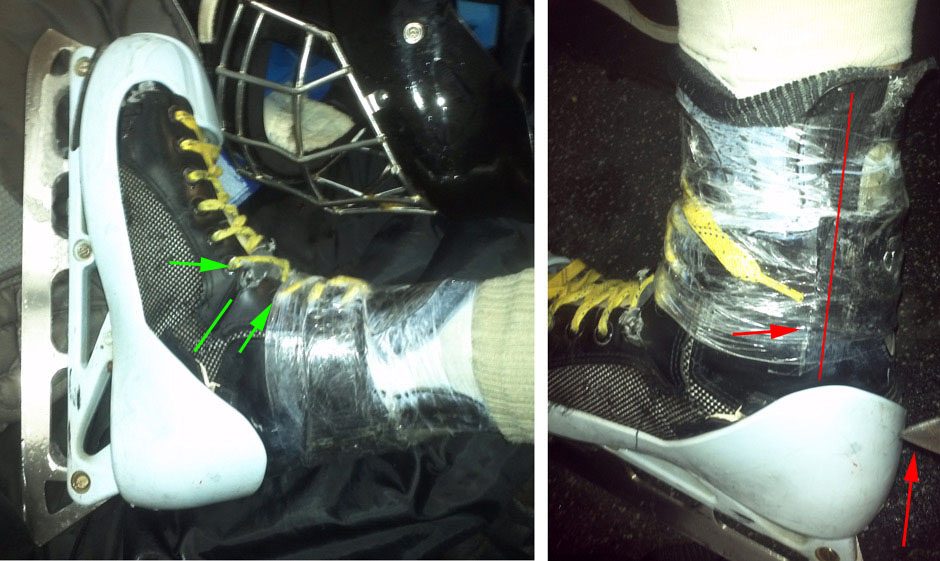
2: Forward lean. Taping your ankle restricts forward lean, which you really need for your stance. Also, I use a forward boot in a goalie shell, so my boot is higher, and this also restricts forward lean. I think that one reason goalie boots sit one eyelet lower is because it allows the goalie to lean forward for his stance. In taping your ankles, you have to allow for this. My boot is not anywhere near the top of the line (old Bauer 1000's) which was why I chose it; most forward boots were too stiff. To allow for more forward lean, I never used the eyelet on the plastic piece (letter 'a' above), and eventually I cut the whole thing off. In the photo below to the left, the two green arrows show the two consecutive eyelets I use, and the line between shows the crease that forms to allow forward lean. It's not as good as a hinged boot would be, but it works well enough. If you're wearing regular goalie skates and you tape your ankles, you'll have to allow forward lean somehow, and all I can do here is show you what I did. You'll need to experiment.
Troy Crowder, who played for the Devils and is a very inventive guy, is developing a pretty neat attachment for the top of skates that will solve this problem. He's making it for forwards, but it will also work well for goalies and it's supposed to be out in a few months. When it comes out, I'll post a link, and I highly recommend it for goalies who don't want to put a forward boot on their skates.

Another problem with taping your ankles is actually very serious, and it is something all hockey players need to know about. When you lock your ankles in and have a tight fit on the skates, every time you lean forward, your heel will dig in to the heel of the skate, causing friction, and, over time, a nasty reaction called heel spurs. I got them years ago from an ill-fitting pair of Bauers (regular goalie skates). Heel spurs can be very painful, and if they don't go away, they can ruin your career. What happens is the constant friction causes the bone to react by swelling until you develop a permanent little bump on your heel. Yes, bone can swell, and once it does, it is very, very hard to bring down. I know one forward who had them operated on and they grew back on their own. Take these little guys very seriously. Having learned from my mistake (that's the only way I learn), I solved the problem in a very simple way. If you look at my skate above, you'll see that the screws attaching the boot are not under the heel, but two inches in front of it (red arrow). This allows the boot to lift very slightly when I lean forward, (red line to blue line), so there is no friction on the heel inside the boot. It also adds a bit to the forward lean. All you need is a very slight lift of a mil or two, and you don't lose any control of the skate.

As I tape my ankles, I test it by wiggling my ankles side to side to make sure it's right. I want just a little bit of side-to-side wobble; just enough for those fine moves you need from your edges. I'll also lean forward to make sure I have the right amount of lean. Below is a shot of how I tape my ankles. With the Step blade, I am taping slightly lower for more control. However, the tongues are really weak and need to be replaced, and the counter is softening, so I'm dreading having to replace these boots, but the point is that my boots are a little weaker, hence, the taping job is likely more severe because of it.

Finally, the last problem is getting the tape off. Forget about peeling it off in the usual way, because that will never happen. What I do is score it with a knife tip, but don't cut into your boot, just score it, then lean your ankle forward and the hole thing will split where you scored it. It takes a few seconds and comes off in one piece that you can bundle up and throw at someone who screened you. Below, the red line shows where to score it (not against your leg, please), the left arrow shows a score mark, and the bottom arrow shows the knife tip.

So that's all for now on the Step Blade and taping. I got the blades at Toronto Hockey Repair (aka Goalie Heaven) and Bryden, who is the only person allowed to touch my skates, put them on. I put this piece up kind of quickly, so I wasn't as thorough as I could be, but if something isn't clear or you have questions, please let me know and I'll fix it. Otherwise, this piece will be moving to its own page to make room for my rant on goalie equipment restrictions.

It's often said that goalies have to be the best skaters on the ice. I don't know if goalies are really better skaters but their movement requirements are far more complex. On any one play, a goalie skate may have to plant the foot solidly to power an explosive move and then stop on a dime, subtly shuffle sideways to keep an angle covered, drop to the ice and then secure one of a wide variety of recoveries. Mobility requirements like these put goaltending on a completely different level than players. The situation also creates a number of difficulties when it comes to getting a proper sharpening.

Players skates (left drawing) really only move in 2 directions, forward and backward. The blades are too thin and too sharp to allow for much sideways sliding other than stops.

Goalie blades (right drawing) must be able to move not only in all four directions but everything in between as well.

This situation creates a skate sharpening problem for goalies because some of these movement requirements conflict. The same blade must be sharp to secure the foot for pushing off but also dull to allow for sideways slide and the problem is, both are essential.

In a push to the right (left pair of skates) the left foot needs a sharp edge to push off from and the right foot needs a dull edge to allow for sideways slide. It's the reverse for a push to the left (right pair of skates). Now the left foot needs a dull edge for sideways slide and the right foot needs to be sharp for pushing off.

So there's the goalies' dilemma, the same skate must be both sharp and dull. Somewhere in between the two is a happy medium that every goalie must find for himself. You can see why goalies are so finicky about their edges. The perfect balance of sharpness and dullness is a difficult thing to find and once you finally have it, getting consistency out of your sharpener or trainer can be frustrating.

Skates that are too sharp will give you rock solid push but your feet will stick. You'll lose the ability to fine tune your angles with small shuffles and shooters will find the holes that don't get covered.

Skates that are too dull will give you all of the sideways slide you need but none of the push. You'll be insecure about your moves because your footing is uncertain. You'll play deeper in the net and go down early and often.

It's critical that you find a cut you are comfortable with. A proper sharpening can cure numerous goaltending problems that remain unsolved. A poor cut can make life in nets a hell.

Overdrive can simplify the sharpening situation by reducing the tradeoff required. You can play with slightly duller skates to get your sideways slide because Overdrive will back up your footing for a rock solid push.

What I Do

I use to have nothing but problems with my edges but happily,
with the sharpening I use now, those days are gone.

When you shuffle sideways, you push off using the inside edge. The outside has to stay out of the way so it doesn't catch and slow you down or even cause a sprained ankle.
The cut I use is called an offset cut, which means that the inside edge is higher (or lower, depending on how you look at it) than the outside edge. The little drawing exaggerates things because it's very hard to see the offset.

This cut works well because on a push, the inside edge is there like a sharp point and on shuffles the outside edge is up and not in the way as much. They still think I'm a little crazy though because I get a very deep (players A) groove. It's way too sharp to use so I then dull it down (mostly the outside edge) until it's comfortable and then it not only works great but also lasts forever. I play a lot, all year long and I'm no slouch when it comes to movement and I've had one sharpening last up to 6 months(that includes summer ice). Also, it seems to survive at least a few hits to the goalpost. It's a real treat to go on the ice and not worry if the edges are going to be all right; in fact I don't even think of them at all any more.

Skate sharpening is a very personal thing so I don't want to dictate here. If you're happy with what you've got then I wouldn't change it but if you're stuck in sharpening hell, you might want to ask around about this cut or at least try a deeper groove and then dull down the outside edge.

Another thing I do for my edges is use a product called 'Sweet Stick' from MiracleStone.


I think it would be a good idea to take a closer at ankles because there have been a number of high profile sprains lately and a proper understanding of this new problem could save you a lot of pain. I've mentioned elsewhere how Overdrive can help reduce sprained ankles so I'll just look at how the problem applies to all goalies, whether they wear the blade or not.
We all know what a sprained ankle is; we've all had one. On the ice it happens when the foot is sliding out or trying to slide. The blade locks and your pushing power rolls the ankle over, pulling the whadyacallit or stretching the doohickey.
Above is a front view of the left foot. Pressure on the foot is in the direction of the big arrow (the foot has to slide out). At some point in the move, the outside edge catches and locks. Since it happens so quickly, you'll still be applying the pressure (big arrow) for the move, only now it'll be used to roll the ankle over. Sprained ankles are caused by the outside edge and if you look at the page on skate sharpening, you'll understand another reason why I prefer the 'offset' cut where the outside edge sits a little higher.


But goalies never sprained their ankles at the rate they're doing it now.

Well, goaltending has become more strenuous and the equipment has not compensated with better protection--protection not from the puck but from self inflicted strains (sound familiar? The 'Safety Movie' linked off the main page also looks at this idea in relation to other injuries).
What has changed is the sliding out move that causes sprained ankles is exactly what goalies are doing a lot more of now. It's not just that there is much more lateral movement now but that it is also of a certain kind.
On a lot of the old moves, the foot would glide out with the blade but now,
the pad must stay face out for better coverage.
Keeping the pads face out means the main blade must slide out against the grain, increasing the chances that it will catch. The potential damage is much greater on the big moves like the butterfly slide of front splits.
Another important factor is that goalies play with their skates much sharper now. A lot of goalies get their skates done after every session and no one uses the crosscut anymore. The strong lateral moves require a solid footing to avoid slipping out and that means sharp skates. However, when the skate is sliding out against the grain, a sharp skate has a much better chance of catching.


So goalie movement is now more dangerous-how has the equipment not compensated? Well the equipment in question is the skate boot and it's ankle coverage. The ankle is only going to roll over and sprain if it can. Let's look at an example.
Imagine wearing a pair of high heels, say a modest pair of evening pumps (kids, DO NOT try this at home!). With zero ankle support when the foot rolls the ankle will roll as well.

Now imagine something a little more sensible. With the ankle properly supported, it won't be free to roll over when the foot rolls. You may go down like an axed oak but since ankle movement is restricted, you won't pull your thingamabob.

On the ice it's a little different. If the ankle was properly supported (long red line), it wouldn't bend when the blade catches . The buildup of momentum that would have rolled the ankle over will be directed into the foot and the ice will likely give way (small red lines).
The problem with goalie skates as they are now designed is that the ankle support leaves plenty of room for the ankle to roll over and sprain. Why is this?
Compare forward and goalie skates and you'll see that goalie skates have one eyelet less so they sit lower on the ankle.(10 vs. 9)

I suspect this was originally done to facilitate leaning forward. When a goalie goes into his crouch, it creates an acute angle at the ankle. A higher boot would resist the goalie and make it harder to lean forward. Also, two side effects of this can be:

-lace bite at the front of the leg-(red X above) as you lean forward a tendon tightens and sticks out a bit (try it, you'll feel it). If it meets resistance it hurts.

-the dreaded heel spurs- (red Y above) tightness at the top of the boot pushes the heel back and as you lean forward it rubs harder against the inside of the boot and hurts as well. You can develop a calcium buildup from this that can cause all kinds of ugly problems.

Lowering the height of the boot makes it easier for the goalie to lean forward and can reduce the other effects.


Instead we get less ankle coverage which can create looseness at the top of the boot, giving the ankle the room to roll and sprain. One thing I've noticed about the new skates is that the ankle padding is so stiff that it is almost impossible to tighten the skates so that they are snug around the ankle. You'll start the game with that loose feeling and as you know, skates laces tend to loosen or stretch or shift a bit as you play and this will create even more room around the ankle.


So given these changes; new movement, sharper skates, stiffer skates,
it's not surprising that goalies are spraining their ankles more.

Is that all? Of course not! Poor ankle support is not only a safety issue but also presents mobility problems (once again safety and mobility are tied together).
Imagine running in loose shoes. Imagine trying to round first base in loose shoes. Obviously, looseness is going to soften your moves as some of the transmission of power will be lost in the 'wobble'. Similarly, looseness in the ankle on goalie skates can soften your moves. When you go to push off, they'll be a slight delay as the transmission of power is interrupted to allow the skate to roll and fill in the gap at the ankle.
So in the drawing to the right, imagine you're trying to push to your right. As your start the push (1), there's a gap between your ankle and the boot. The push does not really start until that gap is filled in (2). Not only is there a slight delay as the skate rolls a bit to tighten up at the ankle, but it also changes the angle that the blade bites into the ice. This higher angle offers a less secure grip.
What can be much more annoying is 'skate wobble' when you need control for intricate moves. If instead of doing one big push you're doing a series of smaller moves, each time the skate leans from one side to the other you'll get wobble.
Of course these drawing don't show a proper boot but they should demonstrate the idea. On moves where the skate is straighter, the boot will roll to fill in the gap on one side (1) but that will open up a gap on the other side (2). On some complex moves you could end up wobbling from side to side.
For instance, imagine a shooter cutting in on the wing, possibly for a shot, and then going behind the net. Following the player in and then cutting to your post and then pushing across hard to the other post, all the while staying prepared for the shot, requires some fancy footwork. The skates will stay close to the 90 degree angle but if each time you shift your weight or turn or pivot the skate wobbles from side to side, then you won't get precise moves, you'll be a sloppy mess.


The problem is not just looseness in the ankle but what this looseness does to your edges. Each time the skate wobbles, it changes the angle that your edges bite into the ice.

When you're doing your moves with the skates near the 90 degree angle (i.e.: straight up and down), it's very easy for ankle wobble to take you from your inside edge (1) onto both edges (2) or over to your outside edge(3). Each one of these can cause problems if it's not what you want at the time. If you don't want your inside edge and the skate wobbles over to it, it'll dig in. If you don't want to be on both edges, you'll skid. If you don't want the outside edge it will dig in and you could sprain your ankle. Obviously this is not the way to get precise movement. On the very moves where you need complete control over your edges, you are likely to have very little.

So there's a quick look at the ankles and whadya know, goalie skates have even more problems. So what's the solution? There isn't one. I have one suggestion that will help a bit but a solution would require a properly designed skate boot and I don't see that happening soon. I always thought the old Micron plastic boot had the right idea. The hinged ankle allowed forward lean without irritating the heel and the boot was slightly higher to stabilize the ankles. Also, there are some rollerblade boots out there that would be excellent.


Taping your ankles can help a lot. Of course, taping tightens the top of the boot around the ankles to form a closer connection. I've always preferred plastic tape because it has some give to it but it can break. Cloth tape doesn't stretch enough and that plastic packing tape is OK but if you let it get wet in your bag, it dies. Be careful about doing the tape too tightly because you'll restrict your forward lean. In fact, you'll have to strike a balance here because the problems associated with a high boot; limited forward lean and tightness at the heel can return. If it's too loose it'll just lift off from the boot halfway through the game and be useless. Leave a tab so you can remove it afterwards or you'll spend 10 minutes picking at your ankles trying to get the stuff off. It always seems to shred on me so I have a little knife also. Just don't slice yourself (do I sound like your mother?). You'll have to experiment here but if you find you've been having any of the problems mentioned above, taping will reduce them at the very least.
Here's a shot of Biron and he's probably used the better part of a roll for both ankles. That can get expensive if you're paying for it. I don't use that much. Also, remember that you still want a little bit of ankle wobble for minor adjustments on moves.
Again, experiment.
Digg Reddit Del.icio.us Stumble Upon Facebook Twitter Google BlinkList Technorati Mixx Windows Live Bookmark MySpace Yahoo Bookmarks Diigo