 |
 |
 |
|
|
|
|


|
The
profly offers much better coverage. You get a tight seal along the ice and the full 11" width of the pad is used for coverage. |
|||||||
 |
|||||||
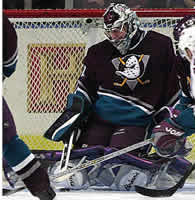 |
|||||||
| The tops of the pads meet to close down the 5-hole (this is even easier if you wear tall pads). There are no gaps and you can quickly pull rebounds into the pads without worrying about the puck slipping under you. | |||||||
 |
|
|
|
|
|
|
|
|
|
|
|
If your knees open up, you not only have thigh boards for coverage but I've found that even the inner knee pads help out along the ice. NOTE: In the left photo: behind those thigh boards are knees! If you remove thigh boards you'll get almost the same coverage when your legs open up, it'll just be your knees doing the covering. See photos below under 'equipment problems'. The NHL effectively outlawing thigh boards was extremely stupid. They were the best protection yet devised for a very difficult and sensitive area. If they felt some thigh boards were too big, then limit the height. |
  |
|
Compare the coverage when one or both of the pads goes face down. |
|
 |
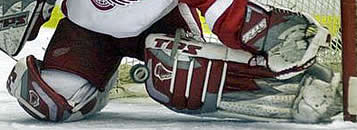
You only get about 6"-8" of the height of the pads and a rebound can go almost anywhere. The 5-hole coverage is poor. Because of the leg angle, it's harder to get a wide butterfly when you're on the face of the pads. |
|
There's
also a nasty hole that forms at the ankle.
Pucks will run the length of the pad and then scoot through. With that hole the pads almost work like a funnel. |
|


 |
(Left) The same goes for the split butterfly. Even with Overdrive, moving out of the split butterfly requires practice and a solid grip. It is extremely difficult on the face of your pads because of the greater friction. |
|
(Right)
The right pad hasn't flipped. You can see that a deflection could easily
run along the inside of the pad. With the pad in a profly, the knee would
roll in and reduce the 5-hole a bit. The inner knee flap would lie on
the ice and if there was a deflection, it might stop the puck from scooting
through. Compare with the Patrick Roy shot above.
|
 |
|
|
|
|
Mobility
is much better with the profly because the side of the pads offer much
less friction with the ice.
It would be very difficult to get much distance on a move like this using the traditional butterfly. |
|
 |
|
|
|
|
Also,
you couldn't do it is because the legs don't slide out very easily in
the old style.The profly allows you to get as wide as your body will allow.
|
 |

|
|
| Actually,
not all goalies are 'profly' but everyone uses it; everyone has to. When
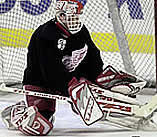
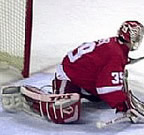
you're down, beyond a certain width the pads naturally flip up on their sides.You just can't get very wide with the pads face down. |
|
    |
|
|
|
|
  |
Mobility can also be easier because the position of the foot puts the blades closer to the ice, so it's easier to recover or move while down. Of course, this is where Overdrive really comes in handy. |
 |
|
In order
to achieve a proper profly, the pads must be loose enough to allow them
to rotate, |
|
First
of all, keeping the toe straps loose allows the toe to drop down into
a more comfortable position. Our feet aren't made to point out sideways
and when they do, it puts a lot of pressure on the knees. With the toes
free, the feet go down closer to the normal kneeling position. Of course
this toe-twisting isn't a problem in the old style butterfly but as soon
as you widen out and the pad flips, you'll need a loose toe strap.
|
||
|
The
traditional butterfly (left) leaves the feet in their natural kneeling
position. The profly (right) twists the toe up. Loosening the toe strap
relieves that pressure by allowing the toe to drop.
|
|
|
|
|
 |
Keeping
the straps above the knee loose allows the pad to rotate without restricting
or pulling on the knee. The knee has to land comfortably on the inside
knee flap and that's a long way from where the knee starts in the stance.
If there isn't enough room, you'll get binding and pulling as you go down
or the knee may get hung up in an awkward position. Keeping things loose
allows the knee to find the most comfortable position.
|
|
Keeping
things loose and allowing the pad to rotate can in some cases reduce how
wide your groin stretches. In the photo (right), if the right pad had
rotated onto its side, it would have brought the leg a little closer in
for the same or better coverage with less stress on the groin.
|
 |
|
I
have some suspicions about this because I know of several goalies who
wear their pads tight, use the profly and have hurt their groin while
widening out. Hopefully on the next update I'll elaborate but I think
tight pads at the knee make the groin widen out more when the pad has
to flip, causing problems on really wide moves.
|
|
|
Having
the pads looser can also save you trouble when you get hit.
|
|
Running
the goalie now seems to be a strategic option and players seem perfectly
willing to risk the 2 minute penalty. People don't seem to realize how
dangerous this can be. They see a goalie with lots of padding and figure
it won't hurt. What they don't realize is that the wider style makes goalies
much more susceptible to career threatening damage. Either on your feet
or down on the ice, the legs are far apart and this places the knees,
groin and hips are in an extremely vulnerable position. Goalies also play
with sharper skates so the risk of the feet locking increases. What you
don't want is anything locking you in position when (not if) you get hit.
We've all heard about how forwards should be loose when they take a hit
and here's where loose pads come in. While deflecting some of the blow,
they'll also give you some 'wiggle room' to reposition yourself as you
get hit.
|
 |
For
example, imagine if Kolzig's mask was firmly fixed to his head. On this
hit, his head and mask would rotate together and his neck would take some
serious damage. Instead, the mask rotated on its own and this reduced
the damage. Similarly, if the pads are loose, then when you get hit they'll
rotate on their own and not take you with them.
|
|
|
 |
|
In the
shots above, the pads are stuck in position.. With tight straps at the
knee and toe, the goalies would be unable move independently of the
pad to avoid damage.
|
 |
Similarly
with these two shots but here I suspect the pads are on a little tighter
and are holding the goalies back.
|
|
|
So that's my look at the profly and hopefully you can see that it offers better coverage and mobility and safety. However, there are a number of equipment problems that you should be aware of.
|
||
 |
 |
| Allowing the pads to rotate requires you to wear the pads loose. I keep the top and toe straps very loose while the calf straps are snug. Some goalies (Roy, Lalime) keep most of the straps loose but I find that uncomfortable. It feels like you lose control over how the pads move; kind of like wearing loose shoes. There will be a fair bit of wobble to your pads and this can slacken your response on some lateral moves and you'll feel like you have to raise your leg a little higher on recoveries. Even with just the top straps loose, the looseness around the knee bothered me. Fortunately, there's an easy solution that solves a few other problems as well. To that end, I highly recommend inner knee pads. They solve this problem by effectively widening the knee, thereby reducing the amount of looseness at the knee. |
|
I've
looked at every model of inner knee protection and none were what I wanted.
These ones came closest (like, 1/2 way there). I lost my last pair and
these ones have not yet been modified but I sort of kept the shape and
improved and adjusted the padding. I like the wing things at the knee.
|
 |
|
I don't know of a better way to solve this problem. Some pad manufacturers (leg pads) include thick inner elastic straps for the knees but I haven't found them to be of any help. The whole idea is to allow the knee freedom to move and if it's restricted by an elastic strap, it'll bind on you. Here's why: |
 |
||||||||||
| When you're standing up, the kneecap is situated at the red 'x' (under the knee flap, of course) and is pointed in the direction of the green arrow. | ||||||||||
 |
||||||||||
| When you're down, the kneecap is now pointed straight down and has moved out to the inside knee flap. | ||||||||||
 |
||||||||||
| The knee rotates(actually it's the pad that rotates) almost 90° and shifts about 3"-4". If you use those elastic straps or keep your knee tight to the pad, it forces the knee to stay in one place('x'). You're going to get binding on the knee because a big change in pad position has to take place. The whole point of loosening your top straps is to free the pad to move. If you loosen the straps and then use those inner elastic knee straps to keep things tight, you are achieving nothing. | ||||||||||
|
|
|
|
|
|
|
|
|
|
|
|
So
that's the looseness at the knee problem. Inner knee pads allow you to
keep the knees loose for movement and they fill up the empty area that
is created so your pads don't wobble.
|
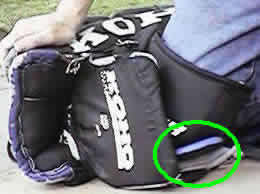   |
| Here's a look at the knee arrangement on my old pads. While the thigh boards cover the knee area better than anything, they can leave a hole in your protection where the green circle is. Inner knee pads solve that but they do shift during a game and leave a hole at the red circle. |
|
|
|
| The knee travels a fair distance (from A to B). This rotation and the way your knee lands will push the kneecap in the direction of the green arrow. Obviously, you want to minimize any effect this may have because repetition will lead to weakness or injury. This is another problem that is solved with inner knee pads. You cannot have direct knee to pad contact because of how much everything moves. An inner knee pad absorbs the friction and creates a buffer zone between your knee and the pad. Even if your pad manufacturer has tried to accommodate the Pro-fly, there is no getting around this one. Do not have direct knee-to-pad contact. |  |
|
Note
that even though I have inner knee pads on, it's still important to have
the area the knee slides through as smooth as possible. Some pads have
ridges and all kinds of stuff that make it a bumpy ride for the knee.
|
|

|
|
||
 |
||
|
The
knees always take a pounding when you go down but it can be worse with
the Pro-fly. This is because you go off of the pad. Notice in the photo
above that I'm on the side knee flap of my pads. Of course, you go off
the pad because it's facing out. So the problem is that the side knee
flap does not provide adequate cushioning for the knee and this can cause
big problems. Although the inner knee pads help, that's not enough. Another
problem is that it'll feel odd when you roll off the pad and onto its
side because you'll go from thick padding to the thin stuff on the knee.
It'll feel like you're falling off an edge, which you are. A number of
pad manufacturers have added padding here for all of these reasons and
this is what I did as well.
|
||
 |
|
 |
| I took this piece from an old pair of pants and added in a few different layers of foam I bought. I wanted it to be large, smooth and have sufficient thickness (I could probably add some more thickness here). Size is important here. Some of the ones that come with pads are too small. When the knee rotates over, it doesn't always hit the same spot. Because the pads are loose, one move can have the knee in one part and another move will put it somewhere else. I didn't want to take a chance that I'd do a move and somehow fall off the padding because it wasn't big enough. | ||
|
Figure
this one out. There's minimal, if any protection of the knee, the padding
on the inner knee flap is too thin and way too small and he's almost off
of it.
|
 |
|
 |
|
|
The profly does put your blade closer to the ice but to take proper advantage of this, it's best to make sure that your toe straps are loose enough to allow the toe to drop down. Otherwise, your foot will be stuck in midair and you'll be no better off. How much to loosen the toe strap is something you'll have to experiment with. The loose feeling at the toe never really bothered me. I think it's something you can easily get used to. If it does bother you, remember that keeping the toe loose is a safety measure as well. |
|
It's
also a good idea to consider the height of your heel off the ice. You
can get a similar effect if the shins get locked up high. While it won't
cause as much stress (since the shin is not a joint) it will raise the
foot higher, making it more difficult to get your skate edges when you're
down. I like my calf straps fairly snug for control of the pad but I believe
this is why a number of goalies keep these straps loose as well.
|
 |
 |
One
thing that can keep the shin high is thick inner leg protection. |
|
||
|
Another thing is the strapping arrangement. I'll take a quick look at my Vaughn Velocities to show how strapping, inner leg protection and inner foot protection can make it harder to get to your edges while in the profly. The Velocity straps are designed to keep your leg and foot in the middle of the channel and they do that very well, that's the problem. When you're down in the profly, even with a loose toe strap, the foot is kept in the middle of the pad and it's very hard to drop it down. The leg is also kept in the middle. |
||
 |
The green box is the pad, the gray diagonal fill is the leg and the blue line is the strap. With the straps keeping your leg in the channel, when you go in the profly the leg hangs there. Your weight is on the straps and that's not comfortable or very stable and it's held up high, making it harder to get to your edges. I changed my straps to a more traditional arrangement so that the leg would drop and the profly would be more stable with the leg on the ice as well. What I did was I moved the inside of the strap (bottom part of blue line) closer to the outside of the pad. The drawing could also illustrate the foot, which was the same situation. |  |
|
|
| Since the whole idea is to have the pads rotate, you'll have to get used to the feeling. Here's where experimentation comes in because you don't want the pads so loose that when you get up, they don't flip back to the normal position. It's never bothered me but sometimes I do have to give them a tap to readjust them. |
