|
| Note: The bottom of this page has my take on the Vertexx cutout. |
 |
Bauer introduced a new cowling a couple of years ago in two variants: the Vertexx cowling with a cutout under the big toe (above right), and a similar cowling without the cutout. The purpose of the cutout was to allow the boot to roll lower, giving your main blade a little more ice time before booting out. Bauer claims 28% more bite, a figure they pulled out of the blue. I explain why at the bottom of the page. As far as the Overdrive install is concerned, all that matters is the type of cowling you have, Vertexx or not. Bauer has put a variety of boots inside the cowlings and given them different names. The 1-100, 1-80 1-60 names from last year are gone, replaced by the Pro, Elite, and Performance, and the Reactor 6000, 4000, and 2000 - six models in all. The Pro, Elite, and Reactor 6000 use the Vertexx cowling. The Performance, Reactor 4000, and Reactor 2000 use the non-Vertexx cowling. Again, all that matters for the Overdrive install is the type of cowling, and I'll look at the non-Vertexx skates first. No matter which Bauer skate you have, it might be a good idea to look at both installs. One good thing about the new Bauer skates is that you will only have to remove one rivet to make room for Overdrive. |
 |
 |
These skates are an easy install, but there is one small change you should be aware of. On the 'General Install' page, I say that the front of Overdrive should line up with the front of the main blade holder, but on all the new Bauers, the green shaded area below curves out and doesn't allow enough room for Overdrive. But with the way the front of this skate is shaped, if you did line up Overdrive with the front of the main blade holder, it would sit too far forward. I recommend moving the blade back a bit to the position shown below. Compared to an install on other skates, you'll have about 1/4" less Overdrive at the toe, where it doesn't get used a whole lot, and you'll have 1/4" more farther back, where it does get used a lot. The blade below was temporarily glued in position at a store and shows the proper front-to-back positioning. The lines on the main blade holder near the front of the blade will be handy guides here. |
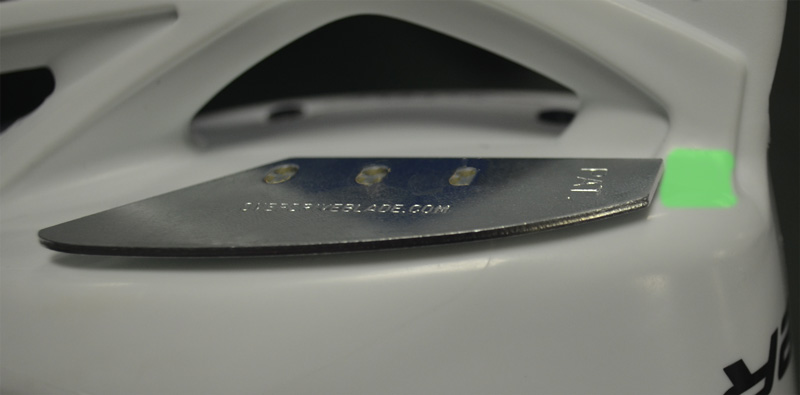 |
Below is another view of the front-to-back positioning. With this size skate, you're close to the rivet at the back of the blade. You don't want to have to remove it, so try and position the blade to avoid it. With smaller sizes, you may have to nudge the blade forward a bit. As a last resort, you'll have to remove that rivet if there is no way to avoid it. Have a look below at the Vertexx below to see a skate with the back rivet in the way. |
 |
 |
|
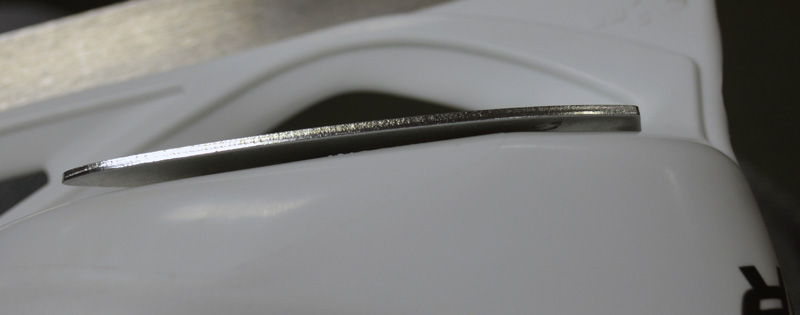
The new Bauers have a slightly rounded edge, which makes it a little more difficult to judge the in-out positioning, but it's hard to go wrong here. That curved part at the front of the boot doesn't allow you to move the blade too far in. Just move the blade to the edge of the boot, give it a little bit more, and make sure Overdrive sticks out evenly from front to back. The blade is supposed to stick out between 1/16" and 1/32", but since the edge of the boot is curved, it's hard to take an accurate measurement. However, if you eyeball this measurement you'll be very close, and close counts here. Run a straight-edge from Overdrive to the main blade (see the bottom of this page) if you want to check that Overdrive will bite. |
 |
 |
|
| The Vertexx install is a bit of a problem because of the cutout, the main reason being that there is not much room to drill the back hole of the blade. Below is a shot of Overdrive on a Vertexx, and you can see that this hole is just on the edge of the cutout. Although this isn't a problem, it would be nice if it had a little more boot to drill into. However, once the blade is on and screwed down tightly, it solidifies the front of the boot and will also protect the black cutout a bit, which, as expected, has had a tendency to loosen over time. Remember that this part of the boot is a very high impact area. Also, this install only used the front and back holes of Overdrive, which I don't recommend; use all three holes, especially for this skate. On another note, this customer used the heavier 4mm. hardware, which uses the same drill size but holds better. If you want this hardware, just ask me for it. |
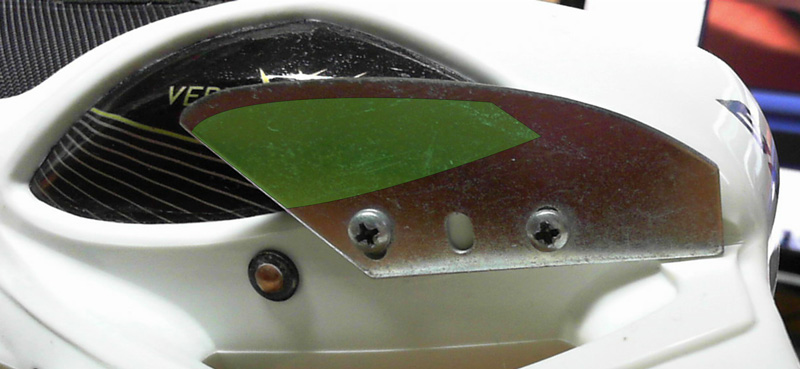 |
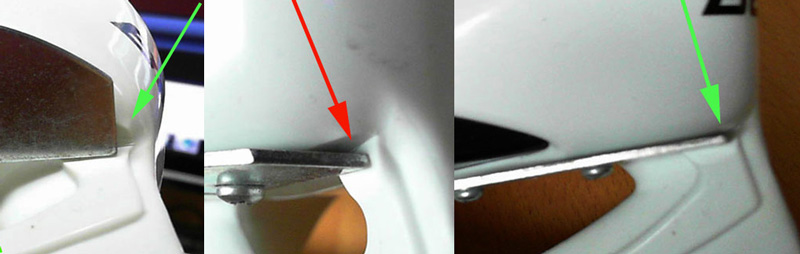
One other consideration is that because of the cutout, a portion of Overdrive will not be backed by the boot. In the shot above, the green shaded area shows the part of the blade that would normally be backed by the boot but is not because of the cutout. On the shot below, the goalie used a black plastic spacer against the cutout (green arrow), but I don't recommended this because the spacer isn't likely to stay put, especially after a few hits by the puck. BK Sports in Ottawa has installed Overdrive on quite a few Vertexx, he doesn't use a spacer, and he hasn't had any problems.
|
 |
With the Vertexx, when the foot rolls over and engages Overdrive, the blade will bend a bit because there is not as much boot backing it up. This will put a little more stress on the screws, which is why I recommend the heavier hardware. This type of stress also happens on the old CCM boot because it is quite curved. I wore them for a few years, and they were a very well designed cowling. Some of the old cowlings were really very good and didn't need to be changed. The shot below doesn't really show just how far the blade sat below the boot, but it did. The green stripe below shows the extra area on this cowling that wasn't backed by boot. Finally, when the blade bends slightly as it engages, it doesn't damage the blade or affect the its usefulness. So, the main considerations when installing on the Vertexx are: |
 |
|
 |
 |
| Front-to-back positioning on the Vertexx is not too difficult because there isn't a lot of room to work with, so it's hard to go wrong. Unless you have and really small size skate and have to remove the second rivet, you're going to be positioning the blade between the rivet and the curved part of the boot at the front (mentioned in the non-Vertexx install). The two shots above show you the two extremes - the top photo shows the blade positioned as close to the rivet as possible, and the photo just above shows the blade positioned just about as far forward as it can go without being pushed out of position by the curvature of the boot. As I mentioned with the non-Vertexx install, try to position the blade closer to the rivet so that you avoid as much of that curved front portion as you can. |
| If you find that you don't have the room for Overdrive, there is another option: you can notch out the front of the skate as the goalie below did. When the Vertexx first came out, my instructions were the same for all skates: line up the front of Overdrive with the front of the blade holder, so that is what this goalie did, by notching out the front as shown below. However, I no longer think that this is necessary, unless it is. All you do is take a knife and carve out a small square. It won't weaken the main blade holder, which is very strong and is attached all over the place elsewhere. Positioning of Overdrive does not have to be down to the millimeter. So this is one option, and you can do it if you feel the urge. I'm going to assume most goalies are not going to want to do this and will just take the simpler option and move the blade back a bit. Below is a shot of how the blade looks on the cowling without making that little cutout in the green shaded area, and it looks perfectly fine. If you move the blade up into it's normal position, then the blade gets pushed out just a little too much |
 |
 |
|
| In-out positioning is very simple because you don't have a choice in the matter, so you aren't likely to make a mistake (knock on wood). Position the back hole of Overdrive as close as you can get to the edge of the cutout, and the shot below shows a safe margin for drilling. You don't want to drill through the edge of the cutout and there's no need to, because this position will give you enough blade to work with. In the shot below, the goalie made that notch at the front, so he has a little more room to drill at the back hole. If you don't make the notch, the blade will shift back towards the rivet, you'll have slightly less boot to drill, but still more than enough. |
|
Below is a shot of how much edge he had after the install |
 |
Below is another shot of how the blade looks on the skate. |
 |
Below is a shot of the blade on (sort of) a Vertexx with a straight edge running from the main blade to Overdrive. This shows you how much Overdrive will grab the ice after it engages. What you are looking for is the distance shown by the red line. The straight edge shows the skate angle when it engages the ice, and the red line shows you how much Overdrive you will have before the side of the boot hits the ice and boots out. If you don't understand that, then pick up your skate and try it, even if you don't have Overdrive on. Anything straight will do. The red line above is the amount of Overdrive for most boots. Actually, you would get a little more than is shown here, because the blade was temporarily glued on and was not straight (green line). If it was straight, it would stick out a bit more, increasing the red line. So, the point of all this is that with a proper install on this boot, Overdrive will work normally. |
 |
|
| On the good side: As I have mentioned many times on this site, narrowing the boot at the toe allows you to roll the skate lower to the ice for more push (see the Graf install page for all the relevant info). With the Vertexx, Bauer has narrowed the boot a little bit by creating a cutout at the toe. This is the opposite of what Graf did with the Cobra, and that's good, but the cutout does not increase your 'angle of attack' by 28%, as Bauer claims. They are just having fun with figures. Most goalie skates bootout at 45 degrees (below, left). With the cutout making the boot a few mils narrower, the skate will bootout a little lower, as shown by the purple line (below, right), thereby reducing the bootout angle to 42, maybe even 40 degrees. This is an improvement, but not a 28% improvement. The green line shows you how much of the boot you would have to cut out for a 28% improvement. 45-28%=33.4 degrees. |
 |
Some people have said that Bauer raised the height of the shell for the remaining 24 degrees of angle-of-attack improvement, much like a Step blade would, but I don't see it. 24 degrees is a lot (a whole lot) and you would be really high. Below is a Graf and a Bauer matched up, and you can see that the blades (red arrows) both touch the opposite boot equally. Try this at a store and you'll see. Put them side-by-side and look at them head-on and you'll get the same result. The heel of the Bauer may be slightly higher, but I don't see the point of wearing high-heeled skates, unless you want to throw your balance off. Bauer does offer a narrower blade, but this will not offer more than a miniscule improvement in angle of attack, if any. The only way you can increase your angle-of-attack is by reducing the width of the boot or increasing its height, and if Bauer has done either, then they certainly haven't done so to the extent of a 28% improvement. They came up with a number (28), so they are measuring something. What is it they were measuring, before and after, to come up with this figure? They don't say. At this point, the question becomes whether you want to trust a company that makes such a claim and expects you to believe it. If you want a better angle-of-attack, then I recommend an RBK or CCM shell with the Step blade (photo of my skates on the Graf install page). The RBK style shell is narrow enough and the Step blade is higher - a nice combination and it works really well; I'm never going back. However, note on the Step Extreme page, that there is a limit to how high you can go before you start to wobble and lose control. |
 |
One other thing that you have to watch for on this skate is that the cutout stays in place. I doubt that it will. The piece is glued in place and then receives two rivets when the boot is attached (red dots, below), but I don't think this will be enough. That is a very high impact area. You'll get a lot of pucks sneaking in and hitting the cutout. Also, when the skate rolls over to its side, there will be a lot of weight coming down on the area, sometimes all the weight of the goalie, especially on a bootout. |
 |
The problem is not the bottom of the piece, but the side of it, where it is not riveted in place. The weakest point will give way, so expect the side to loosen over time. I can't see it lasting more than a few years, and some will give way before that, as I have heard. The piece won't fall off, since it is riveted in, but once it loosens, then you have a problem, because it is a high impact area, and taking a shot there will not be pleasant. The picture below offers an idea of how a puck will get in there. I don't expect this boot to last. In a few years when they realize the trouble it has been and how little extra boot you really get, they will discontinue it, especially if goalies complain about loose pieces and bruises on the ball of their foot. Bauer had the right idea in making the cutout, but it is very hard to implement. |
 |


