 |
||
| June, 2023. As usual, this page is turning into an unwieldy monster. I'm going to upload it in parts and hope I can actually get it done one day. Here is Part 1. It needs edits and and I still have to add voice to the videos, but I have to get this up becuase it's getting out of control. | ||
 |
||
This page will look at how goalies are getting injured and how Overdrive can prevent injury by reducing and/or controlling your widening out. Over the years, this has proven to be a very difficult subject, and I hope this update presents more information more clearly than the last one. I will not be looking at goalie injuries caused by the puck. If you're getting bruised, then I have a long page on equipment repair to fix the problem. Nor will I address injuries from getting run or other impact; that is often just a matter of luck. This page will look at self-inflicted strains resulting from goaltending moves, moves that goalies repeat thousands of times a year, moves that result in repetitive stress and then develop into chronic aches and then then flare up into full injuries, often on seemingly harmless moves. With the video, try watching them repeatedly so the patterns become clear. I recommend this method if you're studying game highlights. The video controls react to mouseover and mouseout, and you can drag the slider left and right for frame-by-frame. Mouse away if the controls get in the way of the action, or you can full-screen it. Below is Malcolm Subban in the fall of '17, and we'll see this type of injury numerous times. It's a move he's done thousands of times, and that's the point. This injury started long ago, building up bit by bit from an ache to a nagging pain until maybe the day before he stretched too much, or lifted too much weight in the gym, or tweaked it in practice. For Malcolm, it came at a bad time, because after being dropped by the Bruins, Vegas picked him up, where a number of goalie injuries opened up a spot for him. Goalies often have to wait years for a chance like that. He's young and should recover, but injuries never really go away, they knock you down a peg, and you only get so many of them before they take you down for good. |
||
|
|
||
He widened out a lot but not excessively, not for a pro in his early 20s. It could be a groin strain, but widening out like this involves many muscles from the knee up to the hip and back. Things can get very complicated, and even the best doctors have trouble zeroing in on the affected tissue. I:n addition, a muscle may be damaged because of tightness farther up the line. This happens a lot, especially with back injuries, in which referred pain leads to a lot of trickery. I'm not going to get too involved here or this page will turn into a book, but I'm sure that most goalies past a certain age have learned that injuries are a bigger mystery than the edges of the universe. Hence, it is best to avoid them in the first place, hence Overdrive. If you watch a young person walking down the street, you'll notice that his stride is long and has a slight bounce to it. Conversely, an old person will shuffle with much shorter steps that are the length of his days. Similarly with goalies; how much they widen out tells you how long they have to go. Luongo had a superb career, but when this injury came along in the fall of '17, the timeline was narrowing. He doesn't widen out all that much, and if you watch the full clip on the web, you'll see the coach wondering what happened. By the time goalies are about 24 or 25, they've reached full flexibility and will progressively tighten because of use and injury. |
||
|
||
But as we saw with the Subban clip above, these simple injuries are now happening to younger goalies. In baseball, Tommy John surgery used to be for older players, but now, you'll hear of a 21-year-old going in for it, sometimes as a preventative measure, but usually because he's been throwing at 100 mph. In hockey, goalies are now going in for hip and groin surgery at younger and younger ages, and it has everything to do with the style they now play. After working their way up from minor hockey to Major Junior, to the ECHL and AHL and finally to the NHL, their lower body has been through many thousands of explosive stretches that the body is not made for. |
||
| Above is Laurent Broissoit's injury, May/23.Like a lot of the injuries on this page, it's a nothing move that he's done a million times. He doesn't widen out much on either the kick or the slide. It's hard to say where it happened or what he injured. It's too bad, because he's 30 and has been through several hip operations, so what you're seeing is the sight of a career evaporating after years of very hard work. He barely got a chance to play injury-free and show what he had. We're seeing a lot of young goalies finally making it, only to be taken down by injury. | ||
 |
||
|
||
 |
||
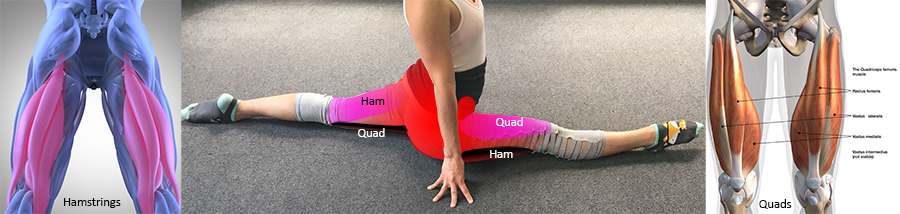
Muscles work in pairs. When your biceps tighten and contract, your triceps must loosen and stretch to allow the move, and then vice versa. The main pairs in the standard splits are the hamstrings (below, left) and the quadriceps (below, right). In the standard splits below, our young lady's right ham and left quad are stretching (black) while her right quad and left ham are contracting (purple). The red coloring of the hip and leg area indicates other muscles involved, but for now, we'll only look at the main muscle groups. The thing to remember here is how big and strong the quad and hamstring groups are. They comprise the bulk of the leg because the bulk of our movements use them. Evolution works that way. |
||
 |
||
In the Chinese splits below, the red coloring again shows the general area involved, but the main groups that stretch are BOTH groins, while both hip flexors and the adductors (purple) contract. On the groin image (below right), the muscle groups are separated onto both legs to show them better. Muscle size matters. In the gym, if you have pencil-thin biceps, you'll have trouble curling 100lbs, but if you have 16" biceps, it's like lifting a latte. That strength is also protection. On the ice, widening out in the standard splits with 100 lbs of pressure on the quads and hamstring is not a problem because they're big and thick, and their job is to raise and lower your whole body. However, widening out in the Chinese splits with 100 lbs of pressure on your groin can overload them because the group is thin (below right) and meant only to work in support of the larger groups. |
||
 |
||
Bailing outWidening out either way is stressful, and it's not hard to overload the muscles when you're sliding all over the ice and moving at explosive speed. As a general rule, if you're entering a danger zone, you need an escape plan. That would involve the reserve strength of the stretching muscle group. What do you do when you anticipate pain? You tighten. If you're widening out in either splits and you get that strung out feeling, those same muscles now have to tighten, and by contracting, they stretch even more, and then they have to hold and stop everything before it goes too far. That is asking for a lot from stretched out muscles. Size matters here.
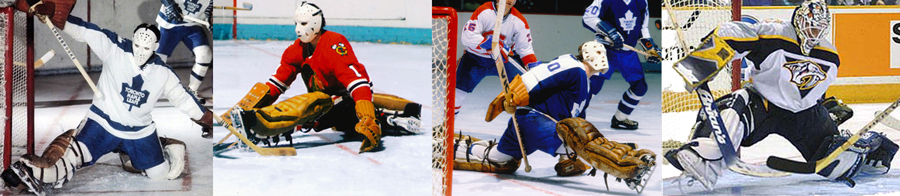
The goalies below are widening out in a standard splits, and let's say this is as far as they want to go. The stretching muscles are 1 quad and 1 hamstring, and these are so big that they will have plenty of reserve power to lock the move, stop it dead, and allow the goalie to bail out of his widening position, usually by rolling back towards the net. Also, note how the heel of the front skate blade is still engaged, adding some control. |
||
 |
||
In the Chinese splits below, the load is on both groins (red), so if you're widening too much, it can be a problem because these muscles are not load bearing, they're not that strong and may not have the reserve power to lock up and tighten. On ice, it's a dangerous situation, because your skate edges are barely gripping or not at all, plus, you're about to go onto your landing gear, which is made to slide. You're basically on a banana peel, and the groin is supposed to hold your position while you bail. The standard escape route is to lock one or both muscles and do a face-plant, hopefully without further strain. Because of its obvious danger, goalies know their limits and avoid damage by bailing early. I can't do the full Chinese splits, my limits are preprogrammed, and as I approach those limits, I bail by locking the legs and falling into a face-plant. It isn't pretty but it works. You'll see that most goalies do this, even ones that can fully widen out. |
||
 |
||
Recent Evolution of Goaltending
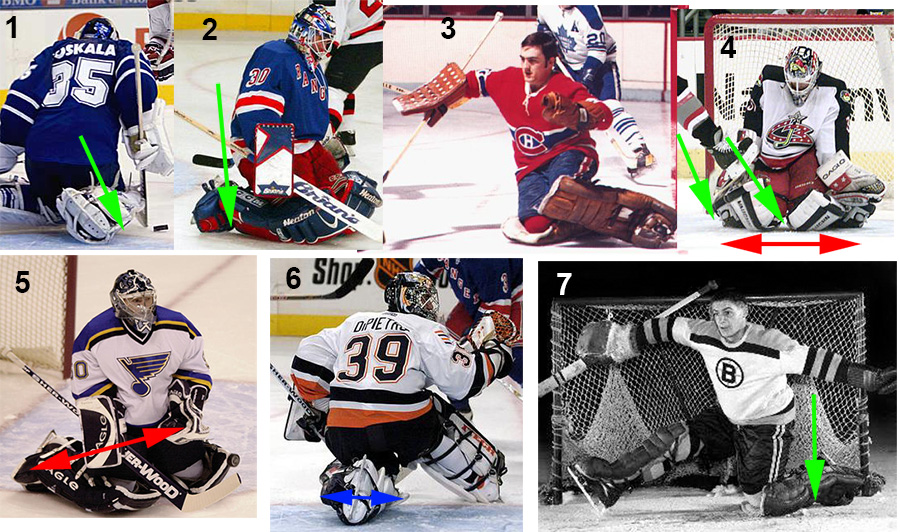
In terms of safety, the standard splits wins out easily, but goalies don't use it anymore because it's not very good at stopping pucks. Everyone uses the Chinese splits to some degree. I suppose it officially began with the simple butterfly, with the introduction of the 'Quebec style' or 'profly' in the early 90s when goalies stopped going down on their pad faces and started going down on their landing gear. Picture 2 shows one of problems with the old butterfly. A puck would scoot along the pad like a mouse and slip inside that hole. Picture 4 shows the hole that formed at the knees. Picture 6+4 shows the narrow width you got. It was physically impossible to flare out the feet for any kind of width. Most of the pictures show how your pad didn't lie flat on the ice, so rebounds were odd and stopping pucks along the ice was tough. I put a pic of Rogie in there not because he looks so good, but because his pads are clearly illegal, especially at the boot, and so is his blocker, and so is Terry Sawchuck's for that matter. As an aside, I will never understand why, during the NHL's crackdown on goalie equipment, they never removed the cuff on the trapper, the part that is actually called, 'the cheater'. When pads went from 12" to 11", I asked why they didn't go down to 10", the historical norm and the intended goal, and the person involved (who just happened to outlaw my blade) said that some goalies were worried about exposing the outer knee when they went down. I could have easily made do with 10" pads and thigh boards (and Overdrive) rather than some of the stuff they did. It is very frustrating and almost unfair when a puck hits the middle of your thigh and still scoots through because of the legislated pant curvature. |
||
 |
||
| (Below) The new style has the pads flip on their sides as you go down so that the full face of the pad is presented to the shooter. This gives you a very nice 11" wall from toe-to-toe with a tight seal along the ice and at the 5-hole. Going down like this also allowed you to flare the feet for greater width. Something that applies to either style is that if you go down with your chest erect, it frees the arms to move easier and provides more coverage. A very tall goalie can go down and have his shoulders almost up to the crossbar. | ||
 |
||
You might say this change happened behind the scenes, and if you want the full story, check with Francois Allaire, ex-goalie coach of the Habs and ground zero of the 'Quebec style', where the changes began in the 90s, likely with Patrick Roy. Although this is an equipment issue, it also has a number of injury considerations. Pad#1 below shows how they used to be in the old days. The landing gear began as a thin layer of foam protection on the calf of the inner leg, and then they added a piece for the knee. Then they added a hinged inner thigh pad and outer leg protection, and as goalies began flipping their pads as they dropped, they needed a thicker knee stack, eventually building it up to 3 or 4 layers. Everything along the inner leg evolved from being protection to 'landing gear', meant to cushion the blow of dropping repeatedly to the ice. The build-up of foam pieces got a little complicated because the whole pad has to rotate cleanly as you drop, and then it has to provide a cushioned landing. This also made the shape of the leg and boot channel an important consideration, because the leg and skate have to drop out of the channel and close to the ice. |
||
 |
||
As well as providing a landing area, the inner pad also evolved to provide a sliding area for all lateral moves, shown as the green area on pad 3. Pad manufacturers promote their pads as having 'Super Slide', and some goalies are waxing this area to boost that ability. A while ago, I worked on a movie, and we wore vintage gear from the 70s, and besides being a very painful experience, it was interesting because the old leather pads had zero slide. The new moves were not possible. I tried a butterfly slide, my pads stuck to the ice, and I keeled over. Back in the day, goalies might use a product called mink oil to make them slide a little bit more, but that also might have been used as a leather preservative. The slide allows the new moves, but I'll also going to show how it contributes to injury. Pad #4 shows a recent iteration (2023) with the landing gear cleaned up slightly. The knee stack has consolidated, and so has the calf section, sort of. You'll also notice that the straps have been replaced by thick elastic with Velcro, which is more comfortable and allows the leg to drop down from the leg channel without having the pads too loose. A big part of the new style is to have the straps very loose, which took a lot of adjustment and some getting used to. The toe strap also had to be loosened quite a bit and has since been replaced by a variety of lace and elastic arrangements. The separate, inner thigh pad has been also been replaced by a separate knee pad, which I hate. Again, the NHL screwed up badly by outlawing thigh boards, which offered the best protection ever and gave the knee all the freedom it needed. The new knee pads are a nightmare, they're expensive, and you'll go through a few before you find one you can live with, one that doesn't dig into your knee at the wrong time. With the new style, there is a lot of motion at the knee with it bending and twisting, as well as the pads rotating and the pants hopefully getting out of the way. Some years ago, I did a page on the pads, here, if you want more info. |
||
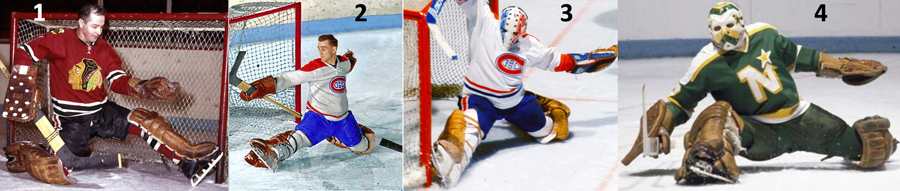 |
||
| Above #1 is Glenn Hall with nothing on the inner leg. The pads were worn tight from the top to the toe strap. From the same era (the 50s) is a stylish Jacques Plante (#2), always the innovator, wearing a knee pad under his socks and with felt padding along his calf. From the mid-70s is Richard Sevigny (#3) with foam wrapped in nylon along the inner leg, and a bigger knee pad under his socks. You can see in #2 and #3 how the left knee almost drops off the pad, and without good knee pads, the move would create some dangerous friction and impact on the joint. In #4, Gilles Meloche (mid-70s) has foam wrapped in leather extending down to his skate, with some felt around the calf that the mice have discovered. Now, landing gear must extend from the knee to the high ankle, and any more is a mistake. | ||
 |
||
The shots above show goalies from about 10 years ago, and while they're going down with their pads flipped, their skates do not have free access to the ice. This could be because the straps are a little too tight, or there is too much calf padding, or the leg channel is holding the skate up. Below shows the current state of the art, with the foot dropping out of the leg channel and right down to the ice. This is important, because if you're not on your edges, you're sliding, and goalies need that main blade to have quick and easy access to the ice for an edge to move with. If it isn't clear now, you'll see it on the videos. The future state of the art will include Overdrive, with even quicker and easier access to a working edge. In the Predator pics (4+5), you can see how much the skate separates from the pad. That few extra inches of coverage that the skate gives can also come in handy, and every goalie has made a toe save from that extra bit of stretch. Just keep in mind that the protection from the new skates without a cowling can soften after a few years. |
||
 |
||
For those who aren't goalies, note how the skates above sit parallel to the ice, whereas in the old style pics above, the skates are toe-down and into the ice. This made it hard to flare the feet out for width, and it made moves while down quite difficult. Now, with an edge closer to the ice, goalies were able to expand on their moves to include pushes left and right while still in the butterfly. Then they widened out those butterfly slides, and they kept widening them until their slides evolved into the full Chinese splits, and now they're doing things like this (below) every game. |
||
 |
||
| The full Chinese splits is now part of most goalies' practice routine and are pretty well a requirement of making the pros because they guy trying out for your spot has them. And note that this is not the 'relaxing on a beach' Chinese splits. Our young lady is leaning forward to take a lot of pressure off of her lower back and core. The goalies below are straightening up their chests because it frees their arms to move and make saves - a much more stressful position. And they'll be moving into that position at NHL speed. | ||
 |
||
So is that it? Has goaltending stopped evolving into something more stressful? Nope. Below is the Reverse Vertical Horizontal, or RVH, with all the goalies against the left post, but either post works. The name is a switch on the VH move, meaning one pad vertical, one pad horizontal. I really like the VH and think that the move should make a comeback because it is a lot less stressful, it loads the legs nicely for lateral pushes, and it just has to be practiced a ton to plug the holes. The RVH is a very good move, it's used by everybody all the time, in fact it's overused so that forwards don't even have to look up to know what you're doing. I'm not a fan of robotic goaltending. The move has fewer holes, with the biggest one between the head and the post, so forwards have taken to banking the puck off the mask or the shoulder. It took them a while but they caught on, and that's the first place they look. And while the move looks rather stress-free, it is not, and certain injury aspects are beginning to appear, notably with the post-side knee. Not only does the knee compress quite a bit, but there is also some lean on the joint. Goalies are using this move ALL the time, but they also have to move into and out of it at a ton, at goaltender speed, so now you'll start to see the problems involved with this move. So is that it? No. |
||
 |
||
|
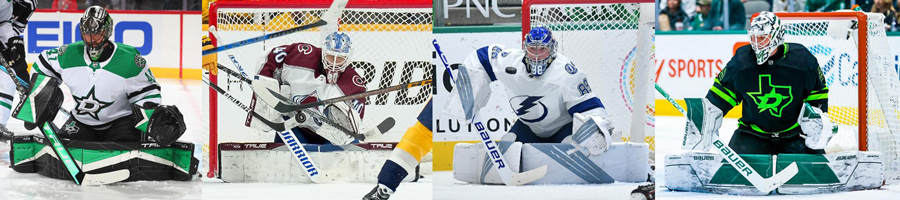
The RVH works on both posts, and as goalies switched from one post to the other, the more flexible among them realized that they could simplify things. Left is Jake Oettinger with both feet on the posts, still able to turn and look behind the net, able to keep his chest up, thereby freeing his arms if they have to move. This is superb flexibility for some fantastic coverage, and I suppose it will be a requirement of all goalies soon. I simplifies goaltending in so many ways and on so many plays. Now, you'll see tall, flexible goalie planting both feet on the posts to create an 11" post-to-post wall. |
||
 |
||
| Below are two views of the same play, a wraparound that Demko stops with his left foot, and you can see how his feet are planted on both posts for some super coverage down low. It is a very hard move just to get your feet to both posts, and it's even harder to straighten up so your arms can move. It places a ton of stress on your lower body and around your knees, but Demko makes it look easy. You need to be tall and very flexible, but, the sad part is that Demko missed a lot of this season because of injury, and I suspect that taller goalies are a little more susceptible to widening out injuries. | ||
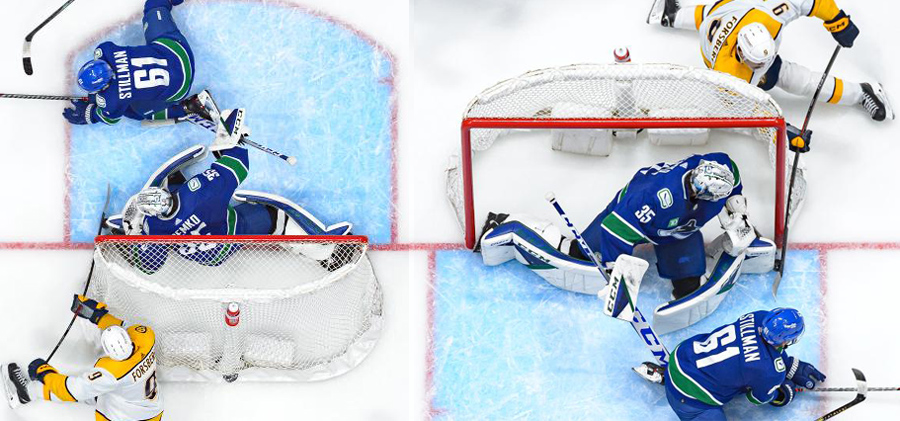 |
||
So it's now goaltending like never before, better than ever, by miles, and this at a time when shooters have better shots than ever and no qualms about unloading one-timers from ten feet out. And this at a time when the NHL has streamlined equipment everywhere it can without endangering goalies. In fact, it's a testament to the equipment now that goalies rarely get hurt by the puck, especially since shots come in fast enough to do some very serious damage. You might get a stinger, and then hopefully the league will allow you to pad your equipment. |
||
At this point, it would be a good idea to put these changes to goaltending in perspective. They are fundamental changes, and we never would have seen a goalie from the 70s, 80s, or 90s doing these new moves. What other sport has seen such changes? Golfers still swing the same, so do baseball hitters, and tennis players, and hockey players still play the same style, all with a little more, but still in the same style. I think you would be hard pressed to find a sport in which players have altered their style as much as goaltenders. The point I will make is that their equipment should evolve to match these changes.
END OF PART 1
|
||

