 |
|
 |
|
Whether you're wearing Overdrive or not, it's very important that you keep the bottom of your pads clear so that they never get in the way of your skates, the reason being that your skates need complete and easy access to the ice, especially when you are down. No edge=no movement. Below is a shot of my skates and pads (Brians Subzeros). When you're standing, the skate will sit in the middle of the pad (below left), but when you go down, the toe of your skate has to be able to drop to the ice (green arrow and middle photo) and there shouldn't be any foam pieces or straps in the way. Even better is if you can drop your whole skate to the ice (below right) so you can use your heel if you need it. |
|
 |
|
 |
|
It may seem obvious that the foot needs access to the ice, but below are two pairs of Vaughan Velocities and the new CCMs on the right. These are some of the best pads in the world, but how is your foot going to drop to the ice with those foam pieces (green arrows) in the way? They're not even attached to the outside of the pad, but right against the foot channel, where they are guaranteed to get in the way. After spending almost $2000 on these pads, the first thing you should do is get an Exacto knife and cut those pieces out if you want to get any kind of movement while down. The bottom of this page has more pad shots. |
|
 |
|
It's not just a question of the foam padding, but also the positioning of the foot strap. Below are: 1-Vaughan, 2-Vaughan, 3-CCM, 4-Brian's. On both Vaughan pads, the attachment points of the straps are to the inside of the foam piece, meaning both the strap and the foam piece are going to prevent your foot from dropping. On the CCM and the Brian's, the strap is attached to the outside of the pad, so if you keep the strap loose, then your foot will have an easier time dropping to the ice. Notice that the Brian's inner leg protection is pretty good, meaning it is up and out of the way. However, I am not a big fan of this strap, because you have to keep it very loose so the foot can drop, and then it isn't doing anything useful, so why keep it? |
|
 |
|
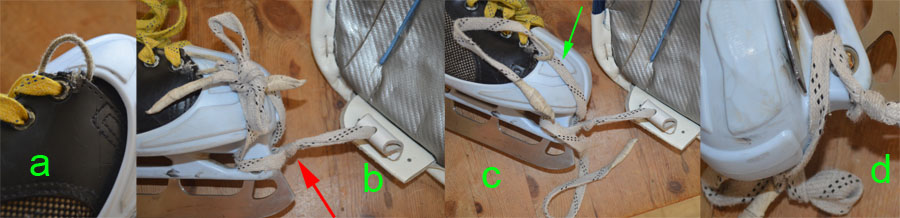
Below is another shot of my pads with a view of what happens when I go down. I use a toe lace and a strap around the high ankle - that's it for down there. Without that strap running through the arch of the foot, the skate can separate from the pad (green arrows below) and really drop to the ice (red arrow below left), as if you weren't wearing pads. You'll get lots of edge as your feet have total freedom to grab the ice, sort of like flippers. One advantage of the foot popping out like this is that when you are stretching out, perhaps on a deke, you'll get a few extra inches of coverage along the ice with your skate. I've had a lot of pucks hit my skate instead of going in. |
|
 |
|
To allow your foot to slide out from the pad like this, your toe lace has to be loose enough. The green line above shows how much slack I give it, and the red arrow below shows where I put the knot. This is something you'll have to experiment with. If the knot is too short, the foot won't drop to the ice, and if it's too long, the lace will buckle while you are standing, and you might skate over it, either cutting it or slipping on it. |
|
 |
|
Just for variety, below is a shot of what I did with my old Brians Thiefs. The yellow X shows the middle of the pad where the old toe bridge would be centered, while the purple X shows the middle of my modified toe bridge, so the whole thing is offset to the inside of the pad because the foot never needs to pivot to the outside of the pad. Some pads (Brians) are now offering an offset toe bridge. The two red arrows show where I drilled two holes (yup, I drilled), then I looped a lace through them, tied a knot and taped it (purple a), et voila, a sliding toe bridge that doesn't cost you $40.00. I loosely tied my pad lace around the loop so it could easily slide from side-to-side with the foot (green arrows). It worked really well and was never a problem. |
|
 |
|
Below is a shot of Crawford's RBKs. The green arrow to the left points to what I think is useless padding that just gets in the way of your skate and reduces mobility, especially when you want to use the heel. The pink arrow to the right shows what this padding is protecting - the heel of his Reebok skates, which already has a heavy plastic shell and the boot of the skate behind it. In fact, RBK thought that this area was so low-impact that they put those triangular cutouts in the heel of the skate to reduce weight. At least they got that right. With the way goalies now play, they is a very slim chance of taking a shot off the heel, and a slim-to-none chance of it actually hurting. I have zero interest in feeling pain, and I beef up my equipment the minute something hurts, but this area is not a priority at all. All that extra padding at the heel is lifting your foot off the ice by almost 1/4", and that is a lot. |
|
 |
|
Below is an example of why you need to keep your heel clear. When that padding gets in the way, it's as though you've slipped on a banana peel. Again, you've got enough protection there with the shell and the boot of the skate, and you'll rarely, if ever, get hit there. I'll only add that while the shorter Graf blade does give you some added agility, at times like this, it's nice to have a longer blade. |
|
 |
|
Below left is a shot of my old Vaughan Velocities from 10 years ago. They were a great pad, pro returns, perfect from the second I put them on. I loved them, but when I got them I had to do some mods. The protection along the skate was way too much, just like the Velocities above, and the green lines show where I sliced it off and sewed it up. It exposed my ankles, but I was wearing the old Bauer shells, which had a lot of protection, so I figured that at worst, I would get a few stingers on the foot, but it never happened, and at the time I was playing a ton. Strap A went around my ankle, and Strap B went under the arch of the foot. I got really good mobility and never had a problem getting my foot to the ice. I wore Strap B quite loose, so it was basically useless, but I kept it because I wasn't using a toe lace. The foot channel seemed to keep things under control; my foot popped out when I went down, and popped back into place when I got up. |
|
 |
|
 |
|
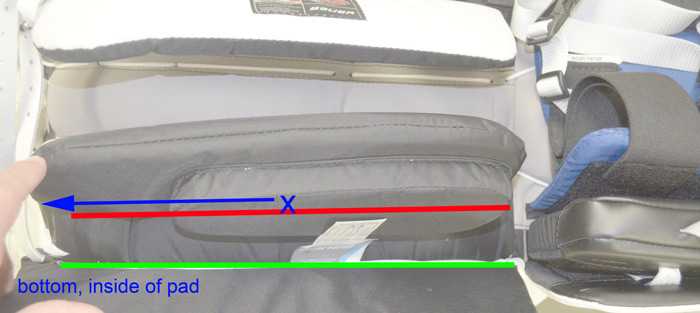
On both of the pads above, I kept all the outer foot protection (green X), because the foot never ever needs to shift to the outside of the pad. As opposed to the inside leg protection, I like this padding to go right down the skate and as close to the leg channel as possible. This gives me some control over the pad to make up for the loss of control from keeping the pads loose for rotation and from having minimal inner leg protection (see below). When I tried the really loosely strapped thing with the outer protection on the outside of the pad (see Crawford's pads, below), I hated it. The pads felt like they wobbled all over the place, I felt slower moving them, and I was never sure of where rebounds were going. I've never liked loose equipment because it moves slower and is harder to control, so outer leg protection like this, especially at the foot, snugs up at least one side of the pad. To the right: the skates always need to drop to the ice (blue arrow), but they never need to shift to the outside of the pad (red arrows). If you don't have snug outer leg protection (green line), when you need to move your pad laterally, (i.e. to cover a pass across the crease) your foot may shift to the end of the red arrows before it starts to move the pad, causing a split-second delay. If you don't have outer foot protection that extends along the skate (purple arrow), when you have to turn, your foot may turn towards the end of the red arrow before your pad starts to turn. It's sort of like wearing shoes that are two sizes too big. One goalie coach said he preferred no outside protection because it allowed the pad to drop earlier to close the 5-hole, but I don't buy that. The 5-hole closes the same either way. |
 |
 |
|
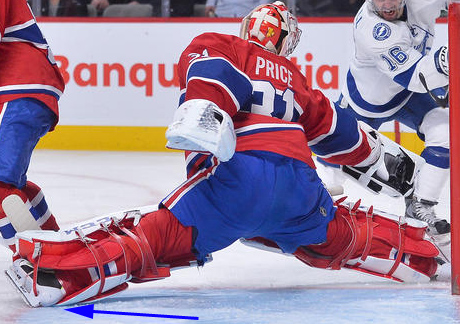
Having better control might also reduce over-rotation of the pads when you go down, although solid landing gear is better at preventing this problem. When the pads over-rotate, they lean back and break the seal along the ice. The goalie above is mid-move, so it's not really an example, but it sort of shows how the pad leaning back can open up the seal at the knee and especially at the toe (blue arrows). |
|
The VH (or split butterfly) is a sloppy move at best, and you'll see goalies getting it wrong all the time on TV. You need to practice it a TON to keep it useful, otherwise, holes form everywhere, especially between the legs (below, green x) and above the near shoulder (below, green a). This move starts with the solid placement of the near leg (below, blue 1), and I found that when the pads were loose and wobbly, it felt like they over-rotated and I wasn't sure where they were, and this uncertainty delayed my closing up of the other weak areas. A lot of goalies wear their pads really loose and like it, so it may be something that you just have to get used to, but I like a lot of control over my equipment. |
|
 |
|
|
Keep in mind that you do need protection on the outer foot. You don't need much, just the foam, but when your skate is at the post and a player tries to bank it in off you, you can take a shot there and it can hurt, and I know of one aspiring pro goalie who had a bone broken in this way, costing him his season. Whenever a player gets angled into the corner and has no more options, he will always look to bank it off you. Below are Vaughan, Vaughan, and Brians pads, and none of them have much outside protection on the skate (green x). This is common, and while there hasn't been a rash of foot injuries in the NHL, I think the protection is worth it, and the extra pad control at the foot is definitely worth it. Also note that below, while Crawford has too much protection on the inside of his foot, he doesn't have enough on the outside of his foot (blue arrow). |
|
 |
|
 |
|
Here, I should also mention a little-known fact about the outer leg protection. The blue line on the left pad above shows Crawford's outer leg protection attached to the outer edge of the pad. Below is a shot of the outer leg protection on my Subzeros, and you can see that it runs closer to the leg channel, giving me one really nice little advantage. Many times as I have gone down, a puck has slipped between my arm and fallen behind me, only to land on the blue area below and stay trapped there. With the pads above, the puck will fall onto the outer leg protection and roll down to the ice (red arrow above on the left pad). His reaching around for the puck may push it into the net, but in any case, it will be trouble. The green lines on the right pad show how my outer leg protection forms sort of a tray for the puck to fall into. Many times, a puck has fallen into this tray and just sat there in spite of my panic - end of play. It really, really helps. |
|
 |
|
 |
|
Another thing to consider when you are buying new pads is the depth of the foot channel on the inside of the pad. One thing I like about the Brians Subzero is that they made the channel quite shallow so the skate can easily drop to the ice. Some other pads have a channel that is almost flat, but I haven't tried them. Although a perfectly flat channel may make it easy to drop the foot, I'm wondering if you lose some control of the pad when you're on your feet. With the Brians foot channel, the pad easily pops back into position when I get back on my feet. In the photo below, the left pic is Brians, the middle is CCM, and the right is a Vaughan V5. The 'i' marks the inside of the pad, the green arrow shows the direction the foot has to move, and the red lines outline the channel. On the CCMs, you can see that the foot channel is a little deeper, and the V5 has a really deep channel. Velocities are a great pad, one of the best, but I'm no fan of the bottom of the pad. However, the outside of the V5 foot channel is very, very good. Deep on the outside is good. The foot will never, ever move to the outside of the pad, so a deep channel on the outside gives you that little bit of extra control of the pad that can come in really handy. |
|
 |
|
 |
|
To the right is another shot of Crawford's foot, and you can see that he runs the toe lace near the ball of the foot. Do not ever do this. There can be no debate here. That lace will gather snow and ice that will double its width and make a really nice slipping point. There is a very good reason why Overdrive goes in this area, and that is the same reason why Bauer put a cutout on the Vertexx. Below is a Vertexx, and Bauer correctly decided that the toe area needs to be as narrow as possible. Running the toe lace through there will add to the width of the skate by the same amount that Bauer thought so important to remove. You can see that the cutout is about the same thickness as the pad strap behind it, so the same thing applies to the strap. Nothing can go in this area. Similarly, do not run a strap past the heel, because you need the heel to move, and that extra thickness, combined with any snow or ice it gathers, will limit your mobility. It will be a very slight change, but if you have a toe lace at the ball of the foot, a strap at the heel, and too much inner foot padding, then it will add up to a noticeable reduction in mobility. Also, if your heel strap is too tight, it will hold up the heel and prevent it from dropping to the ice. Any straps at the skate must run through the arch of the foot and be loose enough to let the foot drop. And as I have mentioned, that means the strap will be so loose that it doesn't perform the function of a strap and is just there for decoration, much like the top, top strap of the pads, which has since disappeared. |
 |
 |
|
 |
|
|
If the inner leg landing gear is not positioned properly, it will hold your leg up when you go down, and it won't matter what is going on at the bottom of the pad, your foot will not drop to the ice (below, blue arrow). I don't know if the goalie below has a problem with the inner leg landing gear or the foot channel, but obviously, his foot is not dropping to the ice. |
|
 |
|
Below is a shot of my landing gear on my Subzeros. The red line shows where your lower leg landing gear should not be. If that landing gear follows the leg channel, then it doesn't matter what is going on at the bottom of the pad, because your foot will never drop to the ice properly when you go down. The green shape shows how landing gear should be - all one piece with a full stack at the knee that tapers down to nothing near the ankle. With this shape, the knee and the leg would absorb the impact of dropping. As it is, I have a gap below the knee stack (blue arrow) where the leg is not supported as I go down, and this puts more of the impact on the knee. Frankly, landing gear drives me nuts. It evolved over the years in a piece-by-piece way, with someone adding in something every once in a while until the landing gear now is more complicated than the pad itself. It desperately needs to be consolidated into an ideal shape that is comfortable and protective. Goalies land on this thousands of times a year, and if it isn't right, it can be very damaging. The whole knee stack thing is silly, because it shifts a lot over time, it isn't stable, and the knee needs stability. Below, pieces 1 and 2 are very soft, piece 1 is not joined to the others, but the two outer pieces are (red circle). All I did was drill a hole and knot a lace - not pretty, but it holds. I'm tired of sewing, and old laces hold really well. By joining the two pieces, they land as one, and this takes a bit of pressure off of the knee, which otherwise would hit the ice first, kind of like a hammer. Finally, I'm not using straps, but went with the Brians Velcro arrangement (blue a), which I like a lot. I didn't think I would, but it worked perfectly from the start. |
|
 |
|
Below is a shot of my leg channel. When you go down, the leg should drop from the green line to the red line, and the channel should be constructed to make this shift as easy and as comfortable as possible. I've never have a problem with this, but these pads are not ideal in this area. To accommodate the drop of the leg, the channel should be smooth, but here, we have (1) soft, cushy foam, (2) medium foam, (3) hard foam, a hard ridge (blue line), and lacing (4). A soft, smooth transition works best. Also note that the inner straps must always attach to the inside edge of the pad (below, purple arrows) or to the inner landing gear. Never, ever should they be attached towards the inside of the pad (below, purple line), or they will hold your leg up. |
|
 |
|
Most pads don't have a problem with the inner leg landing gear, but below is a shot of a pair of Bauers. The green line shows the inside edge of the pad, and the red line shows where the inner layer of foam is attached. From the X and down (blue arrow), that foam should sharply angle down to the green line. |
|
 |
|
Below is a shot of some RBKs. All of the inner landing gear is attached to the inner edge of the pad (red line), though it doesn't look that way. The only thing is it's a little long (red Xs). For better control, I would prefer the outer straps to start along the green line and not the outside edge of the pad. This isn't crucial, but pad control is a nice thing. Other than that, I have numbered each piece of the landing gear, and you can see that this pad has 9 that we can see. I've seen some pads with 14 pieces on the landing gear. This mess really needs to be consolidated for comfort and control. The knee stack is a big pain because the pieces wobble (pink arrows), and that wobble translates to the knee, which over the course of a year and tens of thousands of drops can add up to sore knees. It needs to be rock solid so that when the knee falls on it, there is zero wobble. One thing I like about the Brians pads is that the pieces are Velcro'd together, which reduces all that shifting. |
|
 |
|
 |
|
 |
|
So far, I've been saying that you should allow the skate to drop to the ice so you can improve your mobility, but the most important reason is that it takes pressure off of your knee. Try this now: go down on the floor in a wide butterfly, reach down and lift your toes up from the floor. You can feel the strain in your knees. Try it so you will never forget the reason for keeping your feet loose. If you go down and your foot is stuck up in the channel of the pad because your toe lace is too tight, or you have a strap holding your foot up, then fix it immediately. Normally, when a person kneels, say in church, then the toes are pointed to the floor and the heel is up (yellow line, above left). That is the least stressful position for the feet. Look down at your feet now, they are pointed straight in front of you. But a lot of goalie moves are unnatural, and when you go down, you want the feet to flare out (above left, left foot), and the more flare, the better the coverage. If you practice your flare (get in the position, hold it for a while, repeat), you can get very wide. When I practice it, I can almost go post-to-post (I'm 6'1"), but if my feet weren't dropping to the ice, I could never get that wide. Allowing the feet to drop to the ice takes pressure off the knee and allows you to widen your flare. |
|
 |
|
Although the shots below are of Velocities, most pads are made like this, with a taper at the top and bottom (red arrows, below left). If the NHL is going to give goalies 11", then they should take it, especially at the top of the pad, where that taper can cause problems in the butterfly (green arrow, below right). Without that taper, you might have a problem with the top of the pads hitting each other as you move, but just thin it out. |
|
|
|
|
Also, I highly recommend getting square outside rolls. Anything less will cost you goals. I know, because for the last few years I've had triangular outside rolls, and what happens is pucks will hit the pad, deflect up, roll over the pad, and hop in the net (blue arrows above).The triangular rolls don't stop this as well as the solid square ones. I've had it happen and it is not a happy thing. It's like a mouse has just run up and over your pad, but remember that the puck is an odd shape and can take crazy bounces. In both shots above, the pads are sitting at a 90 degree angle to the ice, but sometimes you'll go down with the pads leaning back a bit, or the shooter will be to the side at an odd angle, and then it will be even easier for the puck to hit the pad and deflect in the net. In the shots below, the right pad of every goalie is rotated back slightly, making it easier for a puck to hit the pad and roll up to the outside roll (red arrows, below right). All of the goalies have a square outside roll. Finally, most pads now have a smooth face, but the old-style ridges (pink lines, above left) would reduce this problem. |
|
 |
|
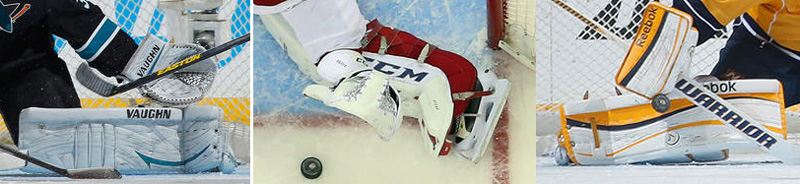
Below are several shots of the foot nicely popping out of the pads. |
|
 |
|
Finally, I had a pair of pads some time ago (Koho pro returns) that had a soft inner edge a little like the RBKs now have, and the great thing about it was that pucks along the ice would wedge themselves in there and die (below, blue arrow). For quite a while now, my pads have had a hard angular inner edge (blue lines below left), and it has cost me a lot of goals. Pucks will hit and run along the length of the pad (red arrow) like a ball on a billiard table. They are very hard to control and you have to dive and squirm to get them. Also, when pucks hit my pad and sit there, it's very easy for players to scoop out the rebound - it's just sitting there, and they can pick it up like they're pulling it off the boards. Many times they have gotten to the puck before I can reach down and grab it. On my old pads, when the puck wedged in there, it was hard for players to dig it out. I don't know if the soft edge on the RBKs does this, but it really helped a lot. I loved it and I miss it. Of course, the question is whether you lose some control on the 5-hole, but after trying both, for sure I would take a soft inner edge. Update: I've asked a few goalies who wear these and they haven't noticed this effect. Too bad. |
|
 |
|
Below is a shot of Ray Emery's pads, a pro return pair, Brians Focus, and the red dot is on the inside of the pad, where you can see that he has a really big piece of foam that will cover the inside of the skate. If you watch Emery on TV, you won't see him slipping out all over the place; you'll just see him shortening up his moves so he doesn't slip out. And that is basically the way he moves. He's not the best when it comes to lateral movement. Similarly, goalies who don't wear Overdrive don't slip out all the time; they just shorten their moves. |
|
 |
|
Below are two more top-of-the-line pads, left is CCM, right is RBK, both by Lefevre. The CCM has inside leg foam going down way too far, and the RBK has the inner leg foam that is not set to the edge (red arrow). I like protection as much as anyone, but you just don't need it here. And if they say it's for comfort when you go down, then put it on the edge of the pad, where it can be just as comfortable. |
|
 |
|
And again, below are two more top-of-the-line pads. Left is the Bauer Total One, right is the new Brians SZII, and both have too much at the bottom. Just because they're all doing it does not make it right, and the info above explains why they are wrong. |
|
 |
|
I haven't mentioned the knee area yet because it's a big subject and it's been a lot of trouble for me. Below left is a Brians Gnetik and right is the 2014 Brians SZII. The Gnetik has an interesting feature that I think is worth mentioning. The green arrows show the attachment points of the knee landing gear. The Gnetik has two attachment points that create a curved gap between them (red arrow, left). The SZII piece is like almost all other pads and has one attachment point, creating a sharp corner (green arrow, right). My previous pads had landing gear like the Gnetik and I loved it because it created a smooth transition for the knee as it rotated from the front of the pad to the landing gear as I went down (blue-ish arrows, left). The curve smoothly directed my knee right onto the landing gear. For the last few years, my pads have had landing gear like on the right, and I don't like it. What happens is your knee can wedge into the corner (green arrow). It isn't comfortable - it's like wedging your knee into a corner. Aside from the comfort issue, you want the knee to land properly on the landing gear so that your pads form a perpendicular wall when down, not leaning too far forward or back, which is what I sometimes get. This causes trouble with the seal along the ice, especially at the top and bottom of the pad. |
|
 |
|
Below is a shot of the best knee landing gear I ever had, and I really, really regret throwing that piece out. It was smooth, so there were no edges anywhere to irritate the knee as it rotated. The foam sandwich was perfect, soft against the knee with some heavier foam on the outside. The nylon was just right - smooth, so it didn't hold up the knee. And it was big, because you don't always land properly. I always hit a sweet spot when I went down and I never, ever landed off the knee pad, which I often do now because they are a little small. I never had the slightest knee problems with this landing gear, and I played a ton at the time. I also had thigh boards, so the protection was total. The NHL outlawing thigh boards was really, really dumb, and it has caused a lot of goalies knee trouble (more on the knee area and thigh boards later). |
|
 |
|
OK, that's about it for now. Any problems with this page or any questions about it, don't hesitate to mail me. J |
|


